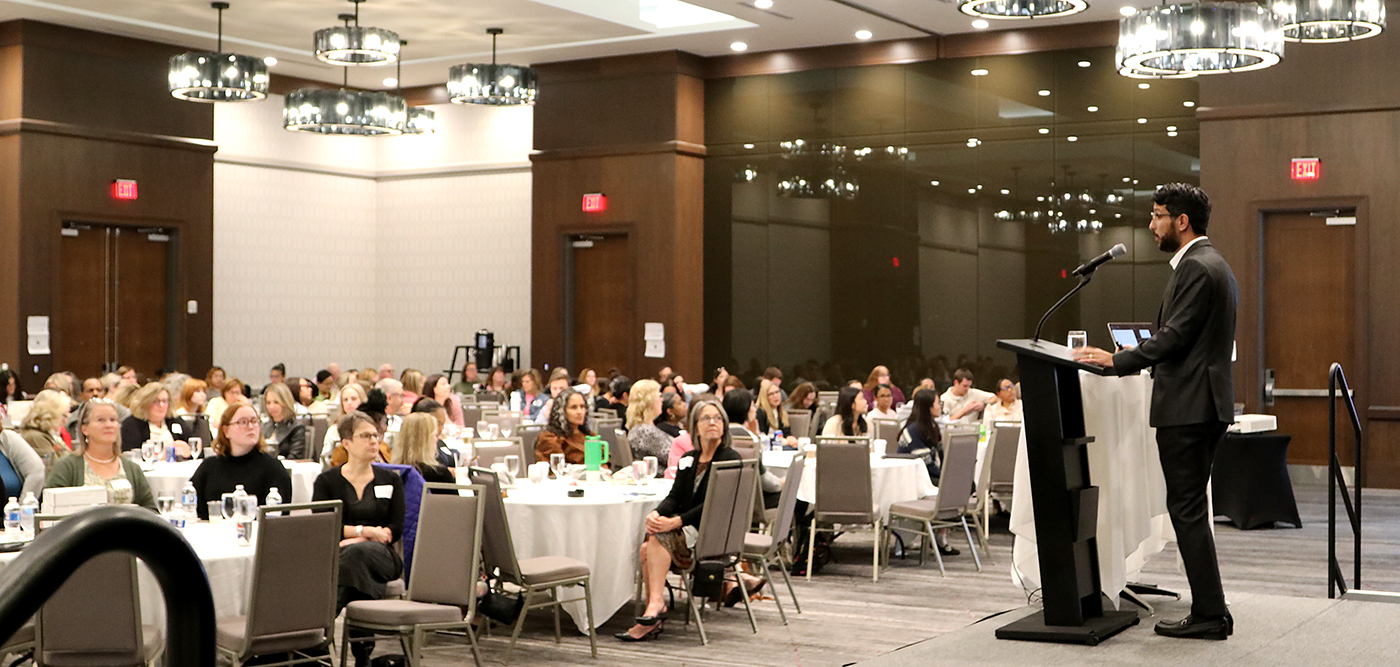
2025 Symposium on Children: Strengthening School Attendance
Across Ohio, schools are facing a persistent challenge: chronic absenteeism. During the pandemic, rates reached historic levels, and today more than one in four Ohio students still miss significant instructional time. Recognizing the importance of attendance for student success, Governor DeWine has made absenteeism a statewide priority, setting a goal to cut rates by half within five years. Districts are responding with preventative measures, and this year, the Crane Center’s 12th Annual Symposium on Children focused on understanding how to strengthen school attendance.
The symposium brought together more than 250 educators, researchers, policymakers, and community partners from across the state to examine the data behind absenteeism and explore strategies to support consistent attendance.

Opening Remarks
Crane Executive Director Dr. Laura Justice opened the event by discussing the organization’s work at the intersection of research, practice, and policy. She shared updates on initiatives such as co-founding the Big Ten Early Learning Alliance and development of high-impact resources like Read It Again! – free, evidence-based curriculum supplements. Dr. Justice also spotlighted the Head Start Child Care Partnership’s birth-to-five continuum of care, and impactful new projects like the Making Every Moment Count, designed to equip early educators with evidence-based strategies. She concluded by celebrating the groundbreaking work of Crane’s faculty on critical topics like student mental health, dual-language learners, and kindergarten transition, highlighting key focal areas in the Crane Center’s research portfolio.

Keynote Presentation
Dr. Arya Ansari, Crane Faculty Associate and Associate Professor at Ohio State, delivered this year’s keynote on the growing challenge of student absenteeism. He highlighted a post-COVID surge in chronic absenteeism – from 15% to 25% nationally – with heightened rates among students experiencing poverty. On average, students now lose 32 instructional days per year, the equivalent of 2.5 years of schooling by graduation, with lasting impacts on academic achievement, mental health, economic stability, and civic engagement.
Dr. Ansari’s research showed that the primary reasons for absence – illness, lack of sleep, and caregiving responsibilities – remain consistent before and after COVID, and that student absences are not linked to teacher absences. His research also revealed two critical timepoints for heightened risk of absenteeism: preschool and high school. Additionally, students’ connectedness, or sense of belonging, appears to result in reduced absenteeism.
When considering ways to address absenteeism, Dr Ansari encouraged attendees to differentiate between malleable factors (such as engagement, school climate, and student belonging) and systemic barriers beyond the school’s control (like transportation and housing instability). Dr. Ansari closed with four calls to action: frame absenteeism as an equity issue, build community partnerships, invest in effective interventions, and center student voices in attendance strategies.

Crane Excellence in Early Childhood Awards
The day also featured the third annual Crane Excellence in Early Childhood Awards, presented by Tanny Crane, CEO of the Crane Group, celebrating outstanding contributions to early childhood across research, practice, and policy.
Below are brief highlights of each award winner and their impact; however, we encourage you to check out their full Q&A to learn more about their incredible work and perspectives on the early care and education field.

RESEARCH AWARD
Dr. Randi Bates, Assistant Professor at the University of Cincinnati, was recognized as an exceptional early career scholar whose work demonstrates rigorous scientific inquiry, innovation in theory and method, and deep relevance for early childhood practice and policy.
Despite being one of the wealthiest capitalist nations, the United States comparatively invests almost the least in public early childhood education. High-quality early education not only supports children during some of the most rapid brain growth in their life but also enables parents to return to and stay in the workforce. Yet without the financial support we see in the K-12 system, early childhood education remains out of reach for most.

PRACTICE AWARD
Brittnii Pina, Director of Quality Education at Cincinnati Preschool Promise, was recognized for transforming early childhood education in Greater Cincinnati through evidence-based leadership, mentoring, and strategic innovation. Her work has expanded access to high-quality preschool for thousands of children, strengthened provider capacity, and advanced equity across the early learning ecosystem.
Imagine a future where early childhood educators receive the same respect, compensation, and benefits as K–12 teachers – a future that draws in passionate, talented individuals and empowers them to stay and lead in the field. Addressing the workforce crisis goes beyond policy or funding; it’s about building a society that understands the transformative power of early childhood education.

PRACTICE AWARD
Heather Null, Lead Teacher at Kent State University’s Child Development Center, was honored for her innovative classroom practices, mentorship of emerging educators, and leadership in culturally responsive learning.
I am most surprised by how quickly children learn and take in new information. They are so observant to adult behavior and will follow their examples. I am always aware of how I speak to children and the amazement of how they can imitate the language I use… It is always validating to see them solve problems positively by repeating words I have shared with them.

POLICY AWARD
Columbus Mayor Andrew Ginther was recognized for his visionary leadership in expanding access to high-quality pre-K, including through the Early Start Columbus program and launch of the Hilltop Early Learning Center.
Earlier in my career, I thought I understood early education. But then we started our work in the Hilltop and my understanding progressed from abstract to concrete. That’s when I learned, more than in an academic way, how tightly early education is bound to non-instructional needs. Health, food security, family support and trauma-informed services are imperative for early childhood success… We learned that boosting positive early-learning outcomes required integrated, neighborhood-level supports as much as classrooms.


Panel Discussion: Policy Approaches and Practices to Reduce Absenteeism
Moderated by Matt Smydo, Director of Education for the City of Columbus Mayor’s Office, the panel featured Valerie Kunze, Administrator in the Office of Whole Child Supports at the Ohio Department of Education and Workforce; Joy Edgell, Executive Director of Preschool and Administrative Services for the Ohio Valley Educational Service Center; and Adero Robinson, Executive Director and CEO of Communities in School of Ohio. Together, they shared insights from state, rural, and metropolitan perspectives on addressing chronic absenteeism, sharing strategies for connection, and leveraging community partnerships to create support for students struggling with absenteeism.
Kunze highlighted statewide initiatives such as Stay in the Game!, a public-private partnership that uses professional sports team messaging to promote attendance and positive engagement. Edgell discussed strategies to improve preschool attendance in non-compulsory settings, emphasizing communication, trust-building, and family support in rural communities. Robinson described how Communities in Schools embeds site coordinators within schools to provide tiered supports and connect families to essential community resources. Panelists underscored the importance of belonging, real-time data, and cross-sector collaboration in reducing absenteeism and ensuring every child has the opportunity to thrive in school.

Poster Presentations
Throughout the day, attendees engaged with poster presentations from the Crane Center and Schoenbaum Family Center, showcasing projects on peer dynamics, paraeducator training, language and literacy development, and even an educational garden initiative – illustrating the breadth of work underway to support young children.

Closing Reflections
The symposium concluded with remarks from Dr. Kelly Purtell, Crane Faculty Associate and Associate Professor at Ohio State, who emphasized a clear theme: chronic absenteeism is a complex issue without a single solution. Addressing it will require a multi-faceted approach, and each person in the room – whether working in research, practice, or policy – has a role to play in implementing strategies that foster connection and engagement for every child.
Additional Photos from the Event
Click to enlarge.
Photography by Austin McClellan, Ohio State’s College of Education and Human Ecology.


In partnership with:
